For the latest information on COVID-19 vaccines, visit https://www.fda.gov/emergency-preparedness-and-response/counterterrorism-and-emerging-threats/coronavirus-disease-2019-covid-19.
Indications
- Adults 65 years and older should receive two doses of any 2026-2027 COVID-19 vaccine separated by 6 months (minimum interval 2 months). Available vaccines are Pfizer Cominarty, Moderna SpikeVax, Moderna mNEXSPIKE, and Sanofi Nuvoxavid.
- For adults 65 years and older who are moderately or severely immunocompromised, age and vaccine history determine which COVID-19 vaccine to get and number of doses needed
COVID-19 Vaccine Recommendations for Immunocompromised Older Adult
Note: The CDC has not released COVID-19 vaccination guidance for the FDA approved 2026-2027 COVID-19 vaccines. The table below provides recommendations from prior published guidelines.
https://www.cdc.gov/covid/hcp/vaccine-considerations/immunocompromised.html
The Infectious Diseases Society of America has released guidance for use of the FDA approved 2026-2027 COVID-19 vaccines:
In adults and children with compromised immunity, the IDSA guideline panel recommends administering age-appropriate 2026-2027 COVID-19 vaccinations.
https://www.idsociety.org/practice-guideline/Seasonal-RTI-Vaccinations-in-Immunocompromised-Patients
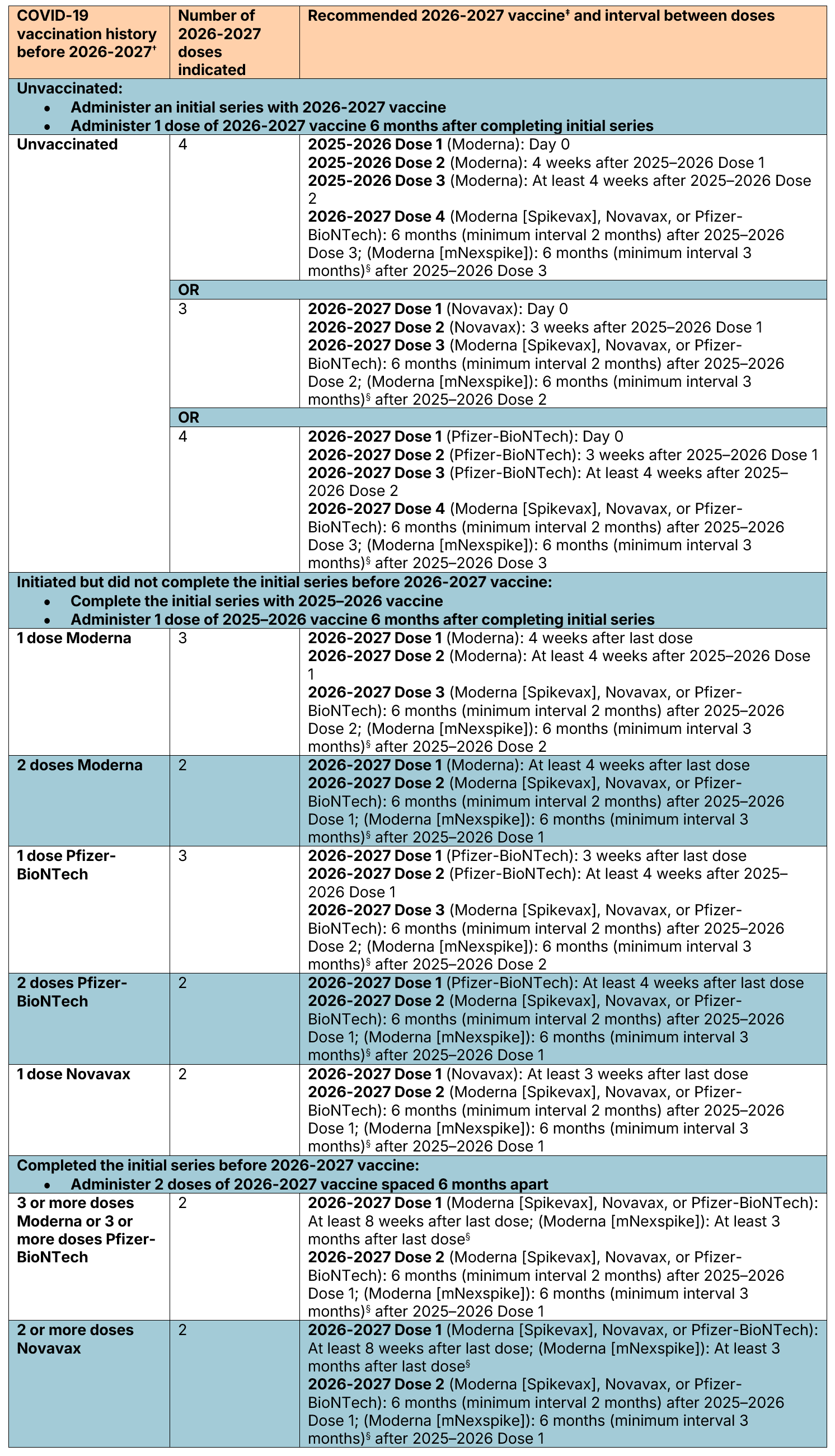
*FDA approval for available COVID-19 vaccines is limited to a single dose of COVID-19 vaccine in this age group for persons with at least one underlying condition that puts them at high risk for severe outcomes from COVID-19. Dosing series is based on recommendations of the Advisory Committee on Immunization Practices from 2024. The recommendation for more than one dose of COVID-19 vaccine in this age group is off-label.
†COVID-19 vaccination history refers to all doses of COVID-19 vaccine from any manufacturer received before the availability of the 2025–2026 COVID-19 vaccines.
‡Dosage for Moderna (mNexspike): 0.2 mL/10 ug; dosage for Moderna (Spikevax): 0.5 mL/50 ug; dosage for Novavax: 0.5 mL/5 ug rS protein and 50 ug Matrix-M adjuvant; dosage for Pfizer-BioNTech: 0.3 mL/30 ug.
§The recommended interval for Moderna (mNexspike) is 3 months after the last dose; however, a dose administered at least 2 months after the last dose should not be repeated.
Contraindications and Precautions
It is rare for patients to have a contraindication to the COVID-19 vaccine. The following are contraindications and precautions to the COVID-19 vaccine:
- History of a severe allergic reaction (eg, anaphylaxis) after a previous dose or to a component of the COVID-19 vaccine.
- History of a known diagnosed allergy to a component of the COVID-19 vaccine.
- History of anaphylaxis after any vaccine other than COVID-19 vaccine or after any injectable therapy (i.e., intramuscular, intravenous, or subcutaneous vaccines or therapies [excluding subcutaneous immunotherapy for allergies, i.e., “allergy shots”]).
- People with a history of a non-severe, immediate (onset less than 4 hours) allergic reaction after a dose of one type of COVID-19 vaccine have a precaution to the same type of COVID-19 vaccine.
- People with an allergy-related contraindication to one type of COVID-19 vaccine have a precaution to the other types of COVID-19 vaccines.
- Special situation: People with a known allergy to polysorbate have a contraindication to the Novavax vaccine vaccine (nuvoxavid, now distributed by Sanofi)
- Moderate or severe acute illness, with or without fever.
- History of MIS-C or MIS-A.
- History of myocarditis or pericarditis after a dose of an or Novavax COVID-19 vaccine.
Vaccine Dosing and Administration
See Indications above
Side Effects
- Redness, swelling at the injection site
- Tiredness
- Headache
- Muscle pain
- Chills
- Fever
- Nausea
Talking Points with Patients
- You are up to date with your COVID-19 vaccines if you have gotten the latest updated COVID-19 vaccine
- Sometimes cases of COVID-19 can be severe and even deadly. This is especially true for older adults and for people with chronic health conditions such as diabetes, COPD, hypertension.
- Getting vaccinated does not prevent getting infected with COVID-19, but getting vaccinated does reduce the risk of severe illness, hospitalizations, and death.
- FDA-approved vaccines are available at no cost to older adults. Can be given concurrently with the flu vaccine.