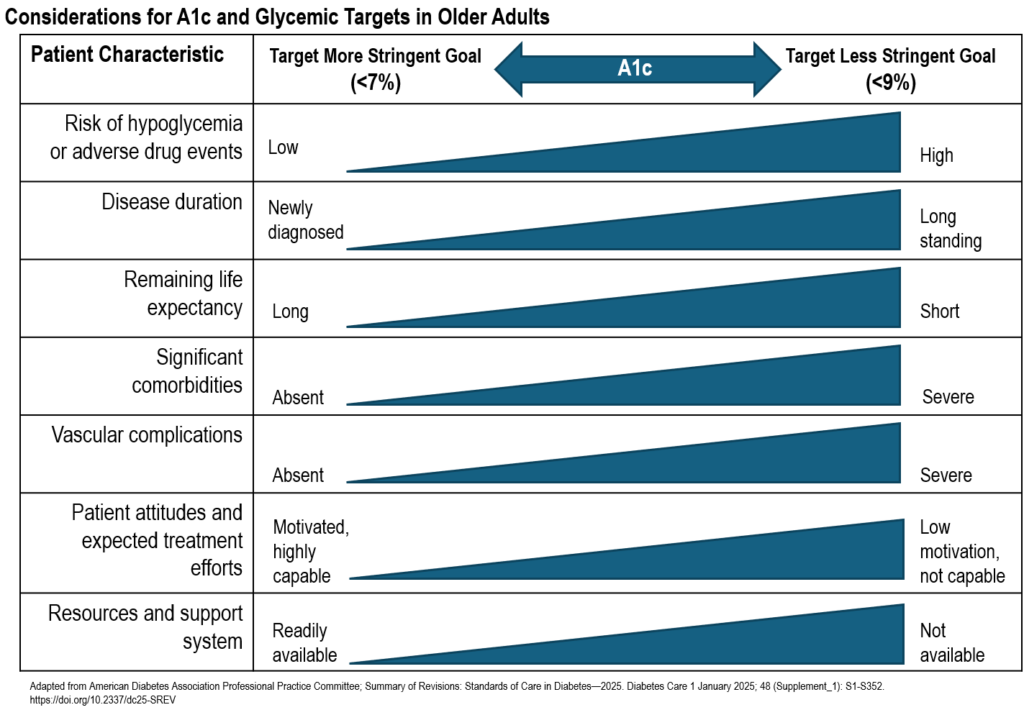
Adapted from American Diabetes Association Professional Practice Committee; Summary of Revisions: Standards of Care in Diabetes—2025. Diabetes Care 1 January 2025; 48 (Supplement_1): S1-S352. https://doi.org/10.2337/dc25-SREV
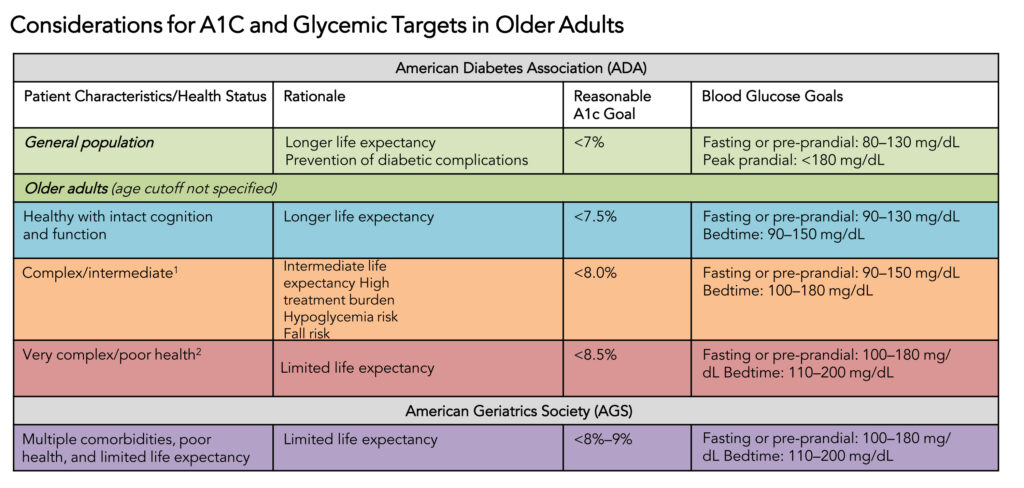
NOTE: The patient characteristic categories are general concepts; not every patient will clearly fall into a particular category. Patient and caregiver preference should be considered for individualized glycemic goal setting. The ADA does not recommend A1c targets >8.5% because they may expose the patient to more frequent higher glucose values and subsequently acute risks (glycosuria, dehydration, hyperglycemia hyperosmolar syndrome, or poor wound healing).
1At least 3 coexisting chronic illnesses (conditions serious enough to require medications or lifestyle management and may include arthritis, cancer, congestive heart failure, depression, emphysema, falls, hypertension, incontinence, stage 3 or worse chronic kidney disease, myocardial infarction and stroke) or 2+ instrumental ADL impairments or mild-to-moderate cognitive impairment;
2LTC or the presence of a single end stage chronic disease illness (stage 3-4 congestive heart failure or oxygen dependent lung disease, chronic kidney disease requiring dialysis, or uncontrolled metastatic cancer) or moderate to severe cognitive impairment or 2+ ADL dependencies.
Sources:
Adapted from American Diabetes Association Professional Practice Committee; Summary of Revisions: Standards of Care in Diabetes—2025. Diabetes Care 1 January 2025; 48 (Supplement_1): S1-S352. https://doi.org/10.2337/dc25-SREV
Moreno G, Mangione CM, Kimbro L, et al. Guidelines abstracted from the American Geriatrics Society Guidelines for Improving the Care of Older Adults with Diabetes Mellitus: 2013 update. JAGS. 2013;61(11):2020-2026.
Munshi et al. Shortfalls of the use of HbA1C-derived eAG in older adults with diabetes. Diabetes Res Clin Pract . 2015 Oct;110(1): 60-65.
Munshi et al. Liberating A1c goals in older adults may not protect against the risk of hypoglycemia. J Diabetes Complication s. 2017 Jul;(7):1997-1999.